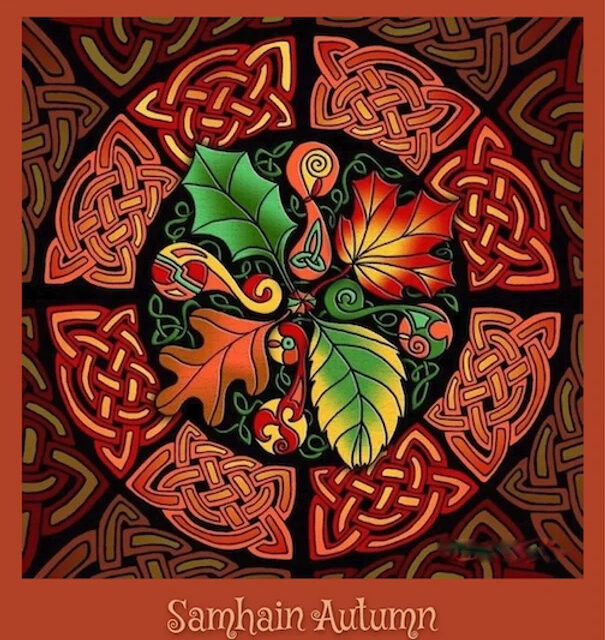
How Samhain, All Hallows’ Eve, All Saints, and All Souls became one long conversation between the living and the dead
By Brian D. Griffin
Tomorrow night the porch lights come on, the doorbells start ringing, and a parade of pint-sized superheroes and ghosts comes up the walk holding out pillowcases. Most of us think of Halloween as a night for candy and costumes and not much else. But the night has a lot more going on than that. It’s the front door to three of the oldest days on the calendar, and they’ve been talking to each other for well over a thousand years.
Start with how the ancient Celts kept time. They counted a day from sundown to sundown, so their great autumn festival of Samhain began at dusk on what we now call October 31. The Church keeps time the same way. A great feast begins with its vigil on the evening before, which is why the Easter Vigil is celebrated on Saturday night. All Hallows’ Eve is exactly that kind of vigil. “Hallow” is the Old English word for a saint, the same word we pray in “hallowed be thy name,” and over the centuries All Hallows’ Eve was shortened to Hallowe’en. So every child in a costume tomorrow night is keeping the vigil of All Saints, whether anybody told them or not.
The Gaels believed Samhain was the hinge of the year. The harvest was in, the dark half of the year was beginning, and on that one night the wall between the living and the dead grew thin. Spirits walked. Ancestors came close. Folks set out food and kept the fires burning.
The Church has its own answer to the thin veil, and it’s a sturdier one. We call it the Communion of Saints. In our faith, the dead aren’t a crowd pressing against a wall that only gives way once a year. They’re family. The saints pray for us, we pray for the souls still on their way home, and the whole household of God, living and dead, stays in conversation year-round. Samhain says the dead come close one night each year. The Creed says they never really left.
You’ll often hear that the Church planted All Saints on November 1 to baptize Samhain, and it makes a good story. The historians are less sure. Pope Boniface IV dedicated the old Roman Pantheon to Mary and all the martyrs on May 13 in the year 609. More than a century later, Gregory III dedicated a chapel in St. Peter’s to all the saints on November 1, and Gregory IV extended that date to the whole Church around 835. Here’s the odd wrinkle: the early Irish church, right in the heart of Samhain country, kept its own feast of all the saints in April. So the overlap may owe more to providence than to strategy. Either way, once the two dates lined up, the old customs and the new feast grew into each other, especially in Ireland and Scotland.
All Souls came along later still. Around 998, St. Odilo, the abbot of Cluny in France, set November 2 aside for his monks to pray for all the faithful departed, and the practice spread across the Church from there. That rounds out the three days. There’s the eve, when the old world feared the dead. There’s the feast, when we honor the saints already home. And there’s the day we pray for everyone still on the road, including our own.
You can trace trick-or-treat right through all of it. In medieval England and Ireland, poor folks and children went “souling” in the days around All Saints and All Souls. They knocked on doors and promised to pray for the household’s dead, and in return they got a soul cake, a small spiced bread often marked with a cross. Up in Scotland and over in Ireland, a custom called “guising” grew up alongside it, with young people going house to house in disguise, partly for fun and partly, the old stories said, to blend in with whatever spirits were out walking. Put the two together, and you get a kid on your front porch with a pillowcase. The original bargain was simple. Candy for prayers.
The jack-o’-lantern is Irish too. Families hollowed out turnips, carved faces in them, and set a glowing ember inside to ward off the wandering dead. A folk tale grew up around the custom about a man called Stingy Jack, who was too crooked for heaven and too clever for the devil, and so was left to wander the earth forever with a coal in a hollowed turnip to light his way. When the Irish came to America, they found the pumpkin, and anybody who has ever tried to carve a turnip will tell you the pumpkin was an answer to prayer.
Even the bonfire belongs to this story. Samhain was a fire festival, with great fires lit on the hilltops to mark the turn of the year. And the word “bonfire” really does come down to us from “bone fire.”
For those of us with a Franciscan streak, there’s one more thread worth pulling. In his Canticle of the Creatures, St. Francis praises God for “Sister Bodily Death,” from whom no one living can escape. He didn’t call her an enemy. He called her his sister. These three days are about learning to be on speaking terms with her. On the 31st we laugh at death, dressing up in skeletons and sheets and carving grins into pumpkins. On the 1st we celebrate the ones who’ve already made it home. On the 2nd we remember our own, light a candle, and say their names. Our neighbors in Mexico keep the very same days as Día de los Muertos, with marigolds and sugar skulls and a place set at the table for the ones who’ve gone before, and they understand the spirit of it as well as anybody on earth.
And for those of us in the Labor Movement, there’s a voice from Samhain country that ties the whole season together. Mary Harris Jones, the woman the coal miners called Mother Jones, was born in Cork, Ireland, and she spent her long life organizing the working people of this country. She gave us a line that could serve as the motto for all of Hallowtide: “Pray for the dead and fight like hell for the living.”
Halloween, All Saints, and All Souls take care of the first half of that.
Every other day of the year belongs to the second.

