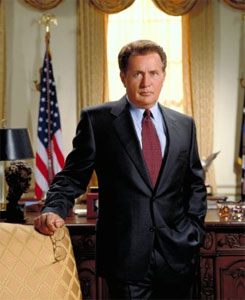
When Aaron Sorkin gave us President Josiah Edward Bartlet in The West Wing (1999), he gave Democrats a dream. Bartlet was brilliant and flawed, moral and principled. He made politics feel noble again. He quoted scripture and Nobel economics in the same breath, believing government could still be smart, decent, and good.
For a party searching for hope after impeachment, cynicism, and scandal, Bartlet became not just a character but a standard. He was the leader we wished we had, maybe even the leader we thought America deserved.
But the dream carried a curse. Too many Democrats came to believe that politics was about the perfect speech, the righteous moral stand, the clever argument that could melt opposition.
While we were scripting fantasy debates, Republicans were mastering the mechanics of raw power. They seized statehouses, redrew districts, stacked courts, and built an entire media ecosystem that spread grievance and falsehood with industrial efficiency.
Fox News, Breitbart, talk radio, and social media disinformation became the new town square. While liberals were quoting Bartlet, the right was remaking reality itself.
The result is the country we inhabit now. Trust has collapsed. Only 32 percent of Americans say they believe the news (Reuters Institute, 2024). Sixty five percent say politics makes them feel exhausted (Pew Research Center, 2024).
Truth itself has become negotiable, facts tribal, and democracy little more than a battleground of spectacle. Leaders are judged less by their vision than by how loudly they can shout, how thoroughly they can humiliate their enemies. This is not Bartlet’s America. It is ours.
Even Barack Obama, the closest thing we had to a real-world Bartlet, could not escape the trap. His eloquence lit the world, but the compromises of governing dimmed the glow.
Joe Biden leaned on pragmatism and deal making, but pragmatism cannot compete with the myth of a president who never lost a fight unless the script demanded it. Democrats were chasing lines of dialogue. Republicans were building an arsenal.
Aaron Sorkin himself seemed to recognize this. By 2012, when he wrote the first scene of The Newsroom, the dream had curdled. Jeff Daniels’ Will McAvoy told us what we did not want to hear: America is not the greatest country in the world anymore. Not because it could not be, but because it stopped trying. Because it traded courage for cynicism, and substance for spectacle. That was not just a television monologue. It was a confession. The Bartlet dream was not enough. Speeches without power are empty. Hope without grit is delusion.
So here we are. The vision remains, but the reality is brutal. A movement that believed too deeply in the magic of words is confronted with an opposition that wields power like a weapon. We face a fractured democracy where facts are optional, institutions fragile, and despair widespread.
The call now cannot be for another fictional president. The call must be to ourselves. Citizenship is not sentiment. It is labor. It is organizing our neighbors. It is showing up for school boards and city halls. It is marching when rights are threatened. It is protecting truth in a culture of lies. It is sacrifice, vigilance, solidarity. It is refusing to surrender this republic to those who profit from its decline.
Thomas Paine wrote in 1776 that “we have it in our power to begin the world over again.” That power remains. The better angels of our nature have not abandoned us. They wait for us to rise and claim them.
We could be all that. We should be all that. And if we mean to keep the republic Franklin warned us about, we must choose to be all that. Not tomorrow. Not in the next election. Now.
 Why Eye Write