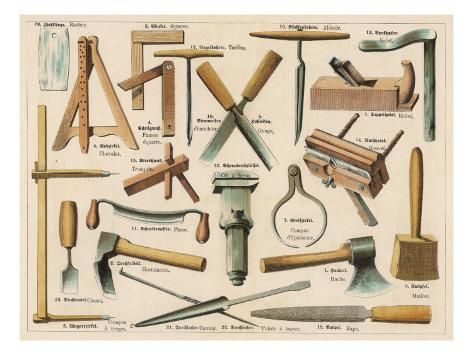
Long before steel beams or silicon chips, before cities rose or engines turned, we learned to shape the world with six simple tools. The lever lets us lift the impossible. The wedge gave us the power to split wood, stone, and history. The wheel and axle carried us forward, first across fields, then across empires. The pulley raised the roofs and monuments skyward. The inclined plane taught us how to climb. And the screw, with its quiet spiral, bound it all together. These were not just inventions; they were revelations. With them, humanity moved from surviving to building, from wandering to dwelling, from chaos to craft. Every tool since is a descendant of these, and in every act of labor… every structure, stitch, rescue, and repair… their legacy endures.
From the moment the first human ancestor picked up a stone and struck it against another, something in us changed. That tool wasn’t just a weapon or a means of survival; it was the first extension of human will. It was an act of imagination made real. A simple edge carved out not just a new way of life, but the very idea that we could shape the world rather than simply endure it.
Tools have followed us through every chapter of human development, such as bone needles and obsidian blades, bronze plows and iron forges, hammers, levels, drills, and code. They built our homes, our highways, our ships, and our satellites. And in return, we built identities around them. We became masons, carpenters, seamstresses, machinists, welders, lineworkers, and pipefitters. The tool became more than a means to a task. It became a symbol of who we are.
But the story of tools is not limited to those that clang or spark or split timber. The public-school teacher’s chalk, the nurse’s stethoscope, the sanitation worker’s route map, the bus operator’s steering wheel. These are tools, too. They may not be forged in steel, but they carry the same weight of purpose. They are wielded with care, passed down in skill and tradition, and used in service to something larger than self. They are the instruments by which entire communities are nurtured, protected, educated, and held together.
And then there are the tools of the firefighter and the EMT—tools of raw courage, sharpened instinct, and split-second decision. The Halligan bar pries open the impossible. The jaws of life tear through wreckage to reach the living. A defibrillator hums with the electricity of second chances. These tools are extensions of muscle, heart, and nerve, wielded by those who run toward danger when every instinct says to flee. These are not tools of routine. These are tools of rescue. Of sacrifice. Of life and death.
In every culture, tools have held symbolic power. The hammer and anvil were divine implements in mythologies from Africa to Scandinavia. The carpenter’s square became a spiritual symbol in Freemasonry. Even in religion, work done with tools is sanctified. Joseph was a carpenter, and so was Jesus. In many Indigenous cultures, the tools used in hunting, building, or weaving are blessed and handed down, connecting generations through use and care.
Across cultures and centuries, tools have marked the passage into adulthood and responsibility. Young Norse received their first knives; Maasai warriors, their spears; Pueblo youth, carving tools or bows. Medieval apprentices were handed hammers or chisels as they became journeymen, while modern-day doctors receive white coats and stethoscopes. Whether a sewing needle, a farming hoe, or a firefighter’s axe, these tools symbolize more than function. They mark a transformation: the moment a person is entrusted to shape the world with skill, purpose, and care.
This is not just romantic nostalgia. It’s anthropology. It’s sociology. It’s soul. The ritual of becoming a skilled worker, whether on the job site, in the classroom, on the ward, or at the firehouse, remains one of the last sacred rites of passage in modern life. To take up a tool is to join a lineage. You don’t simply learn a profession. You inherit it. You stand shoulder-to-shoulder with generations who came before, each one shaping not just materials but values: patience, precision, humility, and pride.
And it is Organized Labor that has carried this mantle most faithfully. We hold the line between the tool as a symbol of dignity and the tool as an instrument of exploitation. Corporations chase efficiency and profit, often severing the human from the hand-tool, or desk, or keyboard, or care cart, in favor of automation, privatization, or burnout. The Labor Movement insists on a different truth: that all work done with care and purpose deserves respect, protection, and dignity.
Whether in the building trades or the public sector, union apprenticeship and training programs are among the last remaining systems where knowledge is passed hand to hand, with reverence and responsibility. Whether you’re learning to wire a building, care for a patient, maintain a transit fleet, battle a blaze, or prepare the next generation of citizens in a classroom, the principle is the same: a union card doesn’t just grant a job. It confers membership in something larger, something ancient. A fellowship of workers who build, protect, teach, heal, and serve.
Today, in a world where so much is virtual, ephemeral, and mass-produced, the tool remains stubbornly real. It demands presence. It requires practice. And when placed in the right hands, it affirms one of the oldest human truths: we were made to make, to shape, to serve, to contribute.
Let others chase the weightless futures of automation and algorithms. We will stay grounded, hammer in hand, stethoscope around the neck, badge on the shirt, axe over the shoulder, because we know: the tools that made us are still the tools that define us. With every tool we lift, whether to build, to heal, to teach, or to save, we carry forward the oldest promise of Labor: that with our hands, and with each other, we shape the world.
 Why Eye Write